 AI Mentorship Hub

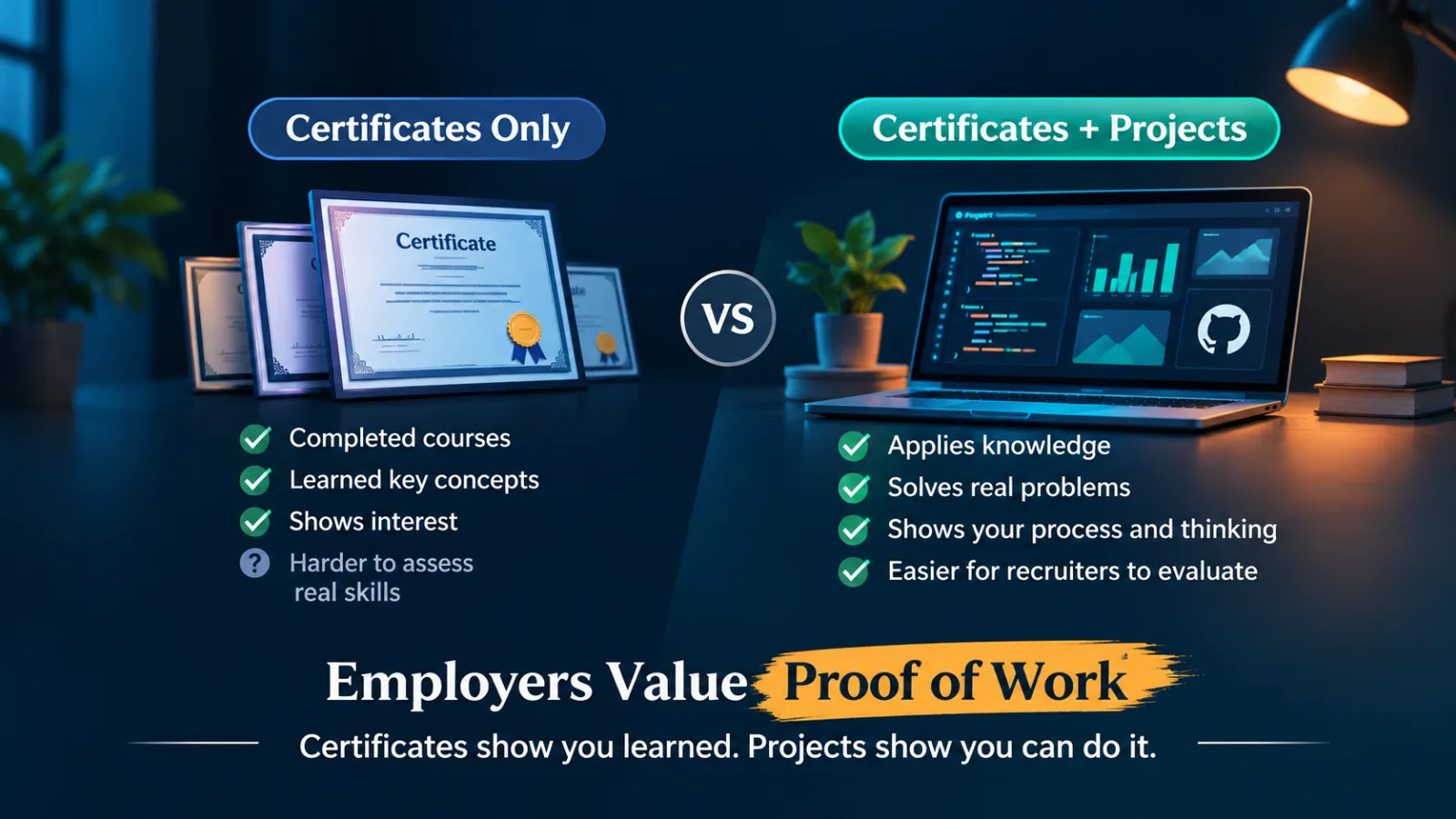
In a competitive job market, a certificate can show that you learned something. A project can show that you know how to use it.
You have completed three online courses. You have earned certificates from reputed platforms. Your resume looks impressive, and your LinkedIn profile has all the right badges.
But when an interviewer asks, “Can you show me what you have actually done with this skill?” — what do you have to show?
This is where many students and fresh graduates face a gap. They spend months collecting certifications but often overlook the one thing that can help employers understand their capabilities: evidence of practical work.
The hiring landscape is changing
Employers are increasingly looking beyond degrees, certificates, and job titles to understand what candidates can actually do.
According to LinkedIn's 2025 Future of Recruiting research, 93% of talent acquisition professionals believe accurately assessing candidates' skills is crucial to improving quality of hire. LinkedIn's data also found that companies conducting the most skills-based searches were 12% more likely to make a quality hire than companies that did not use these searches.
This signals an important shift: employers are not simply interested in what candidates claim to know. They want to assess whether those skills translate into performance.
A certificate may indicate that you completed a course. A project gives an employer something more tangible to evaluate.
What HR professionals actually value
Research from the Linux Foundation's 2025 Tech Talent Report offers a revealing comparison of how technical skills are evaluated.
Hiring factorReported importanceRelevant hands-on experience95%Portfolio and previous project accomplishments85%Certification of skills71%Formal college or university degree65%
These findings highlight the importance of practical experience and demonstrable work. Certifications still matter—but in this survey, hands-on experience and project accomplishments were rated more highly.
The message isn't that certificates are useless. It's that certificates work better when supported by evidence.
Why certificates alone may not be enough
Imagine two candidates applying for the same entry-level role.
Candidate A lists five certifications:
Data Analysis
Python
Machine Learning
Excel
Artificial Intelligence
Candidate B lists three certifications but also demonstrates:
A completed data analysis project
A dashboard built using real or carefully simulated data
A documented problem-solving process
A GitHub repository or portfolio
An explanation of the project's limitations and conclusions
Candidate B gives the recruiter something concrete to discuss during an interview.
Instead of asking only, “Did you complete this course?”, the interviewer can ask:
Why did you choose this method?
What problem were you trying to solve?
What challenges did you face?
How did you interpret your results?
What would you improve if you repeated the project?
A project creates a conversation about your thinking—not just your credentials.
The skills gap is real
LinkedIn's 2025 research found that 73% of HR professionals said less than half of the applications they receive meet all the criteria listed for the role.
Additionally, 63% of HR professionals reported a mismatch between the skills job seekers possess and the skills their organizations need.
This is one reason simply applying to more jobs may not solve the problem.
A candidate may have completed relevant courses but still struggle to demonstrate:
Practical problem-solving
Independent thinking
Technical execution
Communication
Ability to work with imperfect information
Understanding of real-world constraints
Projects help bridge the gap between learning a concept and applying it in a meaningful context.
What makes a project valuable to a recruiter?
Not every project needs to be complicated, expensive, or revolutionary.
A strong project should demonstrate four things:
1. A clear problem
What were you trying to solve, investigate, analyse, or build?
A project becomes more meaningful when it starts with a question rather than simply following a tutorial.
2. Your process
Explain the steps you followed.
Show your methodology, decisions, tools, and challenges. Employers are often interested in how you approach problems—not just the final result.
3. A tangible outcome
Your project should produce something that can be reviewed:
A report
A prototype
A dashboard
A research poster
An analysis
A working application
A documented experiment
A presentation
A portfolio
4. Your ability to explain it
A project you cannot explain is difficult to use as evidence of your skills.
You should be able to confidently describe what you did, why you did it, what you learned, and what you would do next.
Your project doesn't have to be a company assignment
Students often believe they need an internship, a research institute, or a company to gain meaningful experience.
That isn't always true.
A self-initiated project can demonstrate initiative and practical ability when it is well-designed, honestly documented, and relevant to the role.
For example:
A biotechnology student could analyse publicly available genomic data, create a research poster, investigate a biological question, or document a laboratory-based study.
A data science student could analyse a public dataset and build a dashboard that explains meaningful trends.
A design student could develop a case study showing the problem, research, design decisions, and final prototype.
A marketing student could analyse a brand's campaign, create a content strategy, and explain the reasoning behind the proposed changes.
The goal isn't to create something impressive-looking for social media. The goal is to create evidence that you can apply your knowledge.
The certificate + project combination
The most effective approach is not to stop learning or stop earning certifications.
Instead, change the sequence.
Learn → Apply → Build → Document → Demonstrate
After completing a course, don't immediately move to the next certificate.
Ask yourself:
What can I build, investigate, analyse, or demonstrate using what I just learned?
One meaningful project connected to a course can make the learning more memorable and give you something useful to discuss in an interview.
Build a portfolio before you need a job
Your portfolio doesn't need to contain 20 projects.
Start with two or three meaningful projects that demonstrate relevant skills. Document them clearly, keep your work organised, and make them easy for someone else to review.
Your portfolio could include:
Project title and objective
Problem statement
Tools and skills used
Methodology
Your contribution
Results or outcomes
Challenges and limitations
What you learned
What you would improve
This turns your resume from a list of claims into a collection of evidence.
The real takeaway
Certifications help you learn. Projects help you demonstrate what you learned.
In a competitive job market, candidates need more than a list of completed courses. They need evidence of curiosity, initiative, practical thinking, and the ability to turn knowledge into action.
So before enrolling in your next course, ask yourself one question:
“What will I be able to show someone after I finish this?”
Because your next certificate might add another line to your resume.
But your next project might give an interviewer a reason to remember you.
Learn the skill. Build something with it. Show the world what you can do.